The question why do chameleons change color sits next to how, but it is not the same question. “How” points at nanocrystals, pigments, and reflected light. “Why” points at function: what problems does color change solve for the animal? Popular culture answers with one word—hide. Field behavior and laboratory work on species such as panther chameleons point to a fuller list: social messaging, physiological state (mood, stress, arousal), and temperature management, with camouflage as a situational contributor rather than the universal purpose.
This article ranks those drivers carefully, without pretending every species uses color the same way.
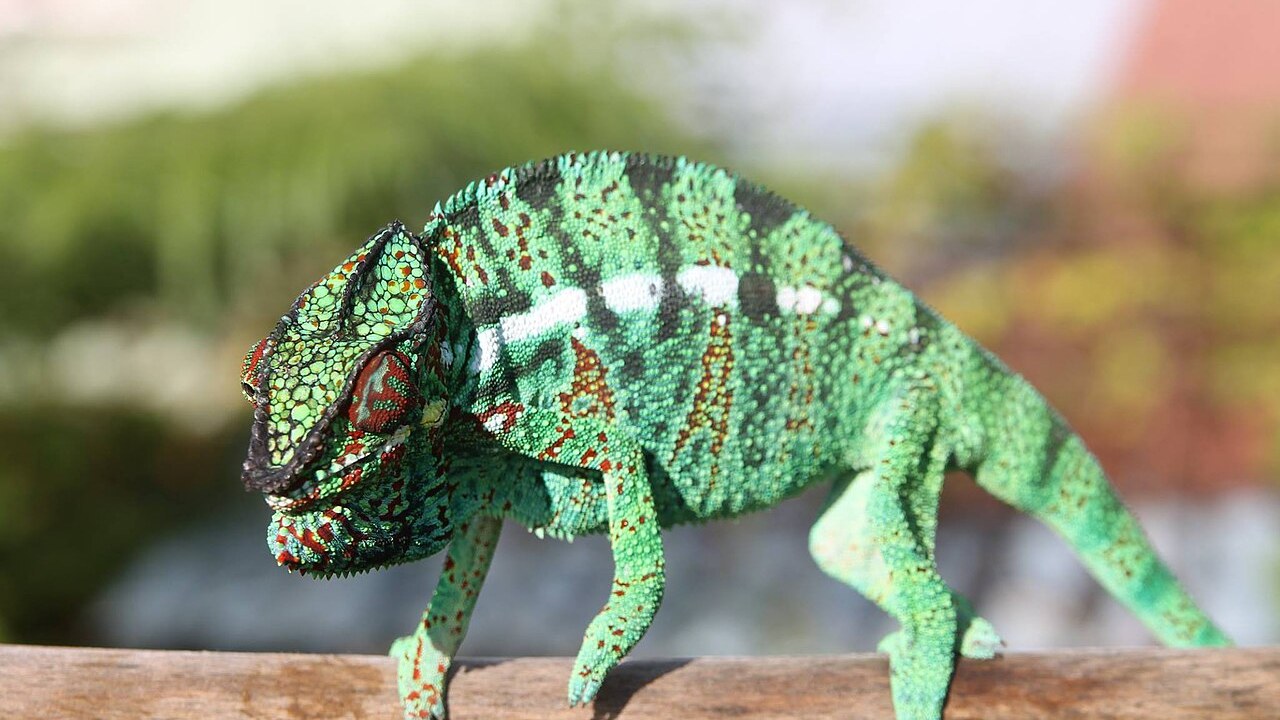
Educational illustration of a social display encounter
It’s usually not “to hide”
If camouflage were the only job, the brightest male displays would be evolutionary oddities. High-contrast yellows, oranges, and reds that appear during contests are easy for other lizards—and many predators—to notice. That visibility is often useful. Signaling works by being seen.
So why do chameleons change color, if not mainly to vanish? Because skin reflectance is a multipurpose tool. The same structural and pigment machinery that can soften an outline against leaves can also broadcast status, courtship interest, or a shift in arousal—and it can help manage heat load. Starting from “hide” flattens that toolkit into a single cartoon function.
A fair reading of natural history therefore ranks functions by context. When two males escalate, communication leads. When an animal moves from shade into cool morning sun, temperature rises in importance. When a quiet individual sits among leaves, crypsis may contribute. The error is forcing one function to explain every frame of the animal’s day.
Mood, stress, and arousal
Color tracks internal state. An animal that is calm, threatened, excited, or socially engaged does not wear the same optical settings. Researchers describe links between physiological arousal and brighter or more contrasting patterns in many display-ready species. Stress and submission can pull appearance toward darker or more muted tones in some contexts.
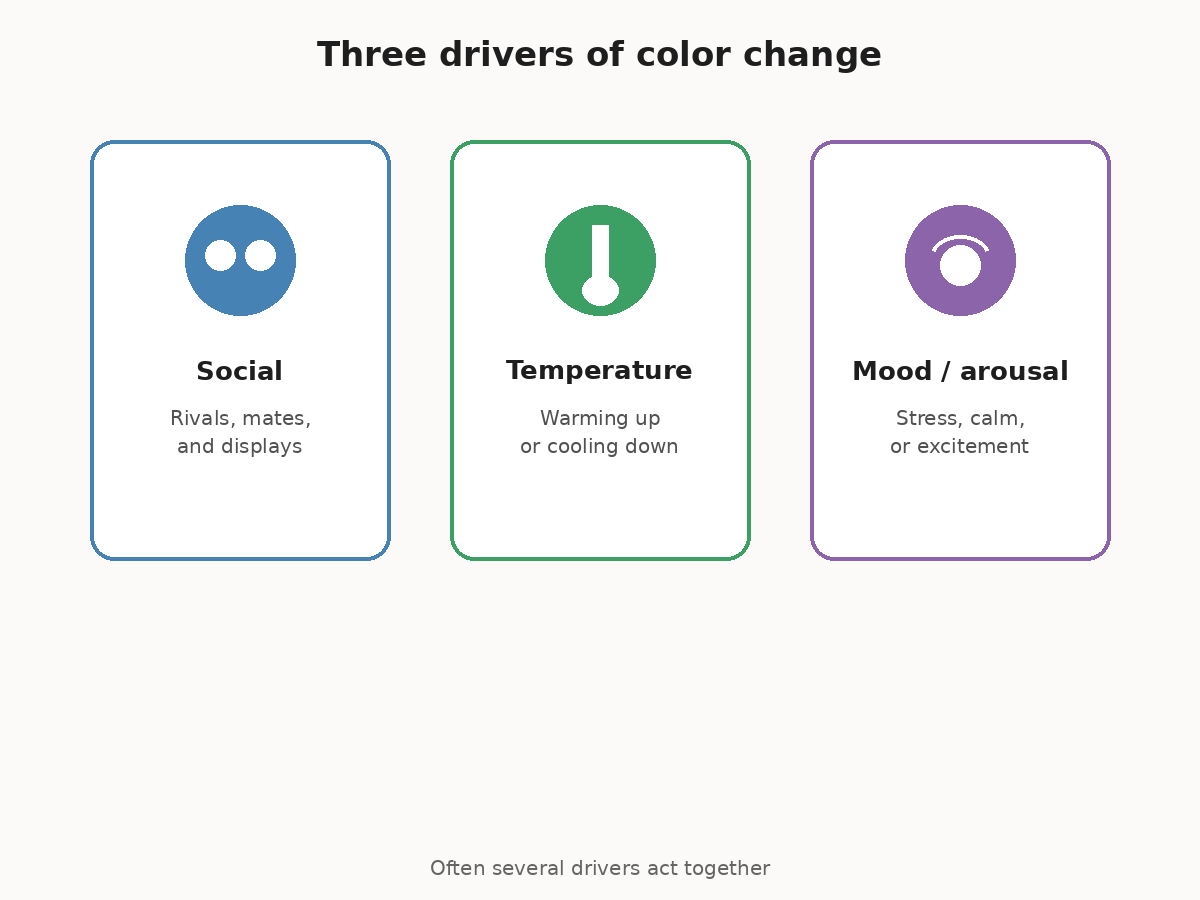
Three common drivers behind visible color shifts
“Mood” is everyday language for those states. It does not mean the chameleon consults feelings the way a person chooses an outfit. Hormonal and neural signals alter skin optics. The molecular details of how those signals resize guanine nanocrystal lattices are still incompletely known; the 2015 panther chameleon study (Teyssier et al., Nature Communications) noted that control mechanisms remain to be determined. Functionally, though, color is a readable output of body state.
For educators and curious readers, that distinction matters. Saying “the chameleon got angry and turned red” is memorable but anthropomorphic. Saying “arousal and social context are linked to expanded lattices and warmer reflected hues in display-ready species” is closer to the evidence—and still accessible once structural color has been introduced elsewhere.
Temperature and body regulation
Chameleons warm and cool with their environment. Skin that reflects or absorbs differently changes how quickly the body gains heat from sunlight. Darker tones can favor warming after a cool night; higher reflectance can limit overheating in strong sun. A deeper layer of iridophores identified in panther chameleons reflects near-infrared light, which researchers discuss as relevant to passive thermal balance rather than to the flashy visible palette of a fight.
Temperature-driven change may look less theatrical than a rivalry display, yet it answers a real “why”: staying within a workable body-temperature range. Social and thermal motives can coincide—an animal can be both displaying and thermoregulating—so motives are not always mutually exclusive.
Because heat and light arrive together from the sun, reflectance in visible and near-infrared bands both matter. That is why discussing only “pretty colors” undersells the physics. Skin is part of the animal’s climate strategy as well as its social strategy.
Communication: contests, courtship, and status
Among the clearest functional stories is communication. Color change turns the body into a dynamic signal.
Male–male encounters
When rival males meet, posture, movement, and color often escalate together. Intensified hues can advertise fighting motivation or condition. A darker, less showy opponent may be less willing to escalate. Observers—human and lizard—read those differences. In that setting, why change color? To negotiate conflict with information, sometimes reducing the need for costly fighting, sometimes amplifying threat.
Courtship signals
Courtship adds another audience. Males may brighten or pattern themselves when approaching females. Females, depending on species and reproductive state, may show colors or patterns associated with receptivity or rejection. The details vary; the theme does not: color participates in mating dialogue.
Communication does not require language. It requires a sender, a receiver, and a cue that correlates with something useful—motivation, sex, readiness, dominance. Chameleon color change supplies that cue on timescales of seconds to minutes when structural lattices shift.
Among lizards generally, visual signals are common; chameleons simply push the dynamic range of those signals especially far in some lineages. Understanding why they change color in contests and courtship is therefore continuous with wider behavioral ecology—not a quirky exception that only camouflage can explain.
When background matching does matter
Rejecting the camouflage-only myth should not become a camouflage-never myth. Chameleons live among leaves, twigs, and mottled light. Adjusting lightness, hue, or pattern contrast can reduce detection by predators or prey in some situations. How much that matters relative to social and thermal needs depends on species and context—a genuine research-sensitive point, not a slogan.
Background matching is often subtler than the fireworks of a male contest. It may involve slower or smaller shifts. Treating every green resting animal as “camouflaging on purpose” overclaims intention; ignoring crypsis entirely underclaims ecology. The balanced view: camouflage contributes sometimes; it is not the headline reason for rapid, saturated social colors.
Researchers who study crypsis also remind us that “matching” is judged relative to predator vision and habitat statistics, not only to human snapshots. A tone that looks “obviously green like a leaf” to us may or may not be the best match for a bird’s or snake’s visual system. That complexity is another reason slogans travel farther than evidence.
Putting it together: one skin, several jobs
Why do chameleons change color? Because one skin serves several jobs:
Social communication — contests, courtship, status cues.
Expression of physiological state — arousal, stress, calm.
Thermal help — reflectance that assists warming or cooling, including near-infrared roles of deeper iridophores in studied species.
Situational crypsis — background matching when ecology favors it.
Those jobs share hardware: iridophores with tunable nanocrystals, pigment chromatophores, and melanin-based darkening, as clarified especially for panther chameleons. Jobs do not share equal weight in every moment. A flashing rival is not primarily hiding. A quiet animal edged into leaf shadow may be doing something closer to crypsis, thermoregulation, or both.
Species caution remains essential. Panther chameleons illuminated the structural mechanism; they do not license identical “why” rankings for every chameleon on Earth. Habitat openness, mating system, predator suite, and body size can all reshape which function dominates. Comparative statements should stay labeled as comparative—not as universal laws derived from one star species.
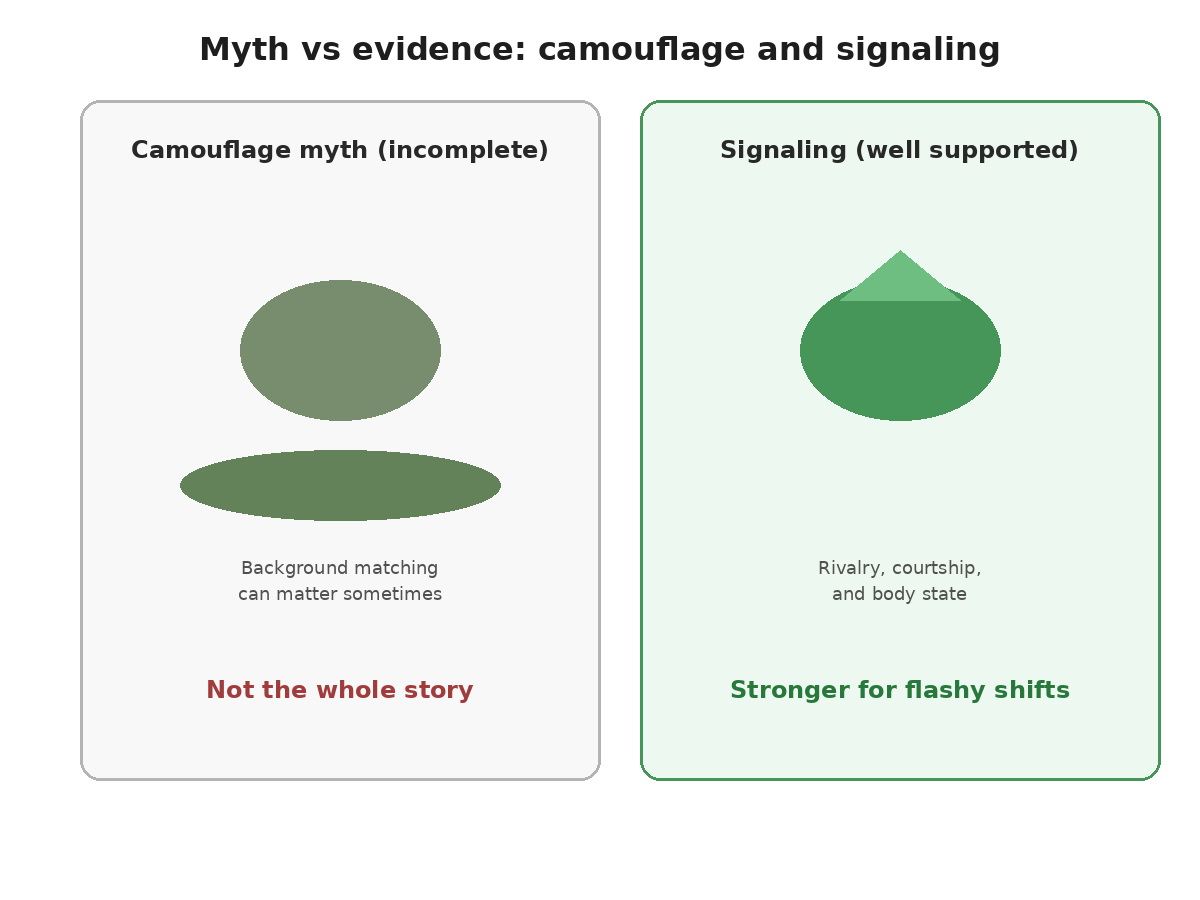
Contrast between a camouflage-only myth and signaling evidence
Summary
Driver
What it helps with
Typical look of the change
Caveat
Mood / arousal / stress
Reflecting internal state
Brightening or darkening with excitement or stress
Not a conscious fashion choice; cellular control details incomplete
Temperature
Managing heat gain/loss
Often subtler shifts; deep layer linked to near-IR reflectance
Interacts with behavior and habitat
Social communication
Contests, courtship, status
Rapid, high-contrast displays
Poorly explained as camouflage
Camouflage (nuance)
Reducing contrast with background
Often quieter matching to foliage/bark
Contribution varies by species and context; not the main story for flashy shifts
Bottom line: Chameleons change color for multiple adaptive reasons centered on signaling, body state, and temperature, with camouflage as a real but frequently overstated piece of the puzzle—not the sole purpose the cartoons advertised.