Chameleons are famous for shifting from calm greens and blues to vivid yellows, oranges, and reds in moments that look almost theatrical. For a long time, popular explanations leaned on a simple idea: the animal “paints” itself with moving pigment, usually to blend into leaves or bark. Modern research paints a richer picture. Much of the rapid change comes from how light bounces off tiny crystal structures in the skin, while pigment cells still shape yellow, red, and dark tones. The animal’s nervous and hormonal systems decide when those structures rearrange—often for social signaling, mood, or temperature, not only for camouflage.
This article walks through that story in plain language: what happens in the skin, what triggers a shift, how camouflage fits in, how fast changes can be, and what we still do not fully know.
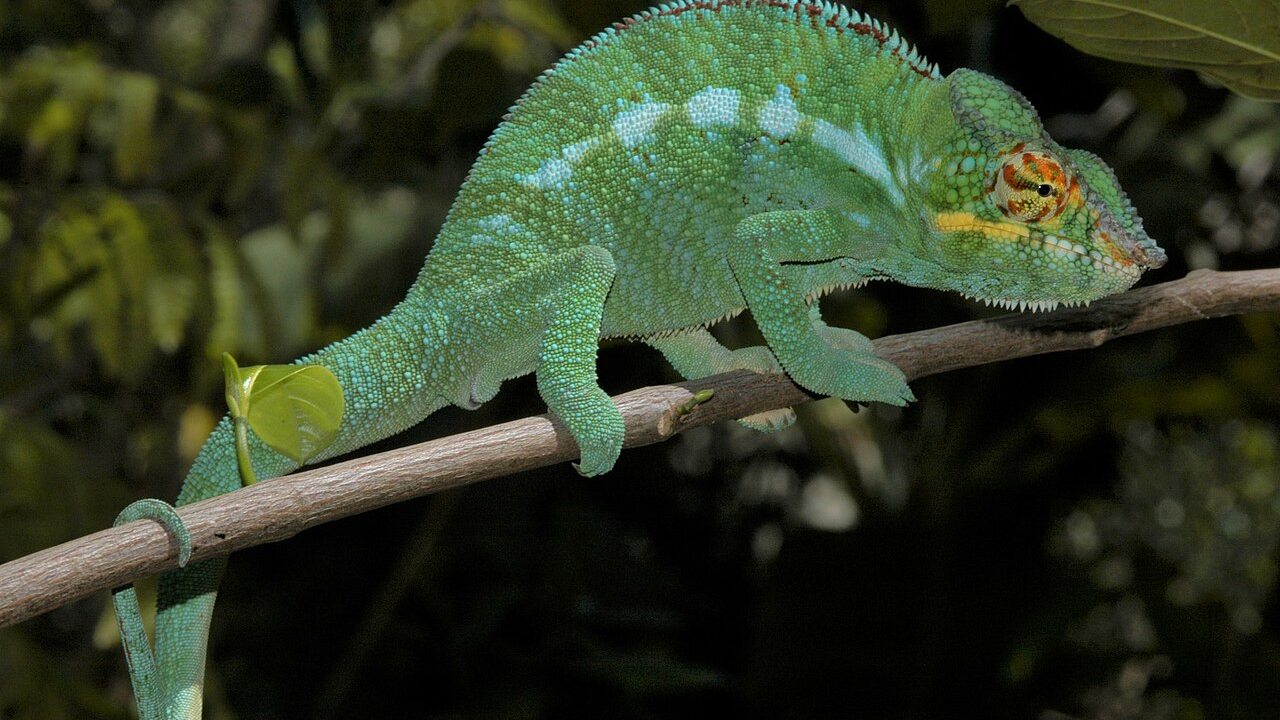
Educational illustration of a lizard on a branch
The short answer
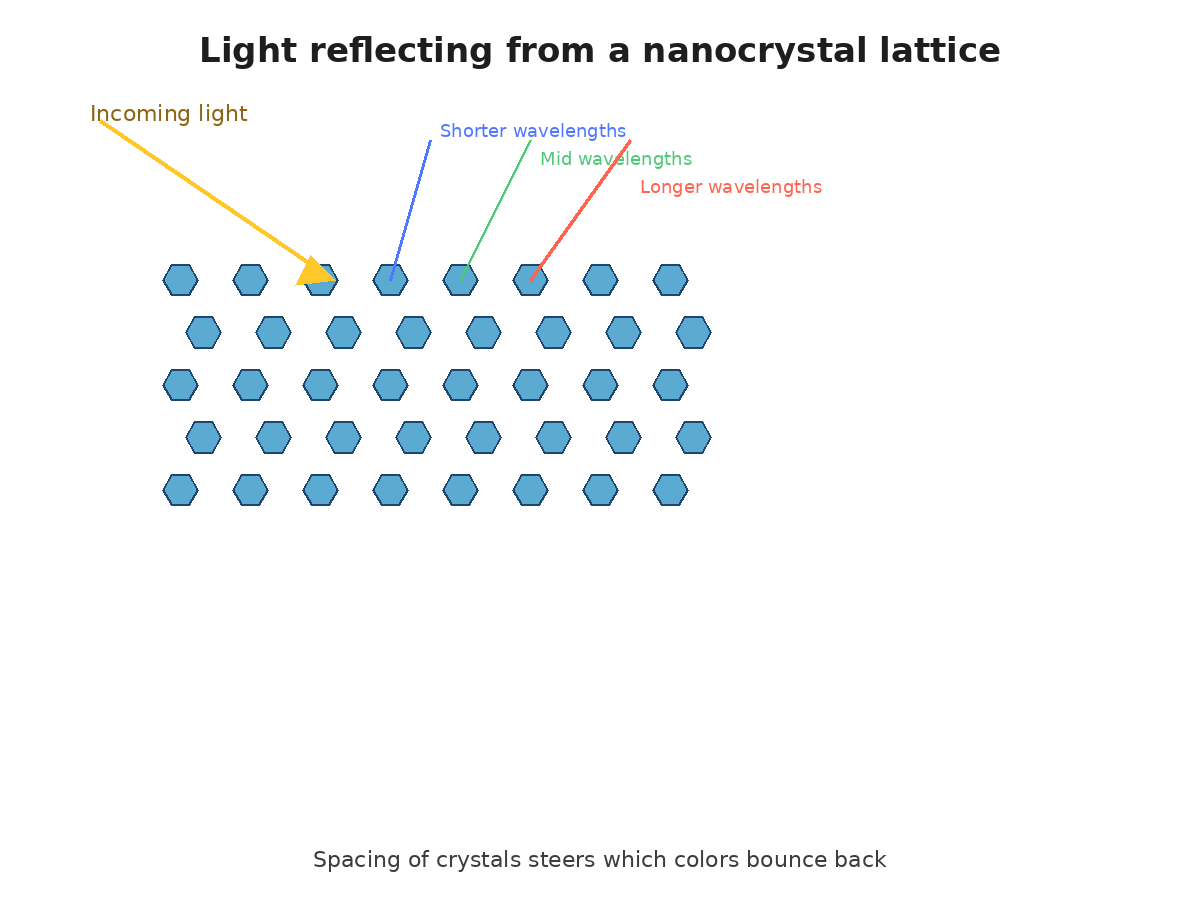
How do chameleons change color? In species that show dramatic, fast shifts—especially panther chameleons, which have been studied in detail—the key is structural color. Specialized cells called iridophores contain lattices of guanine nanocrystals. When the spacing between those crystals changes, the wavelengths of light reflected from the skin change with them. A tighter lattice tends to favor shorter wavelengths (more blue or green appearance, depending on the rest of the skin). A more expanded lattice can shift the reflection toward longer wavelengths such as yellow, orange, or red.
Pigment-bearing cells called chromatophores sit in layers with those crystal cells. Yellow and red pigments filter or tint the light that passes through; dark melanin can mute or deepen the overall look. So the visible color is usually a collaboration: photonic reflection from nanocrystals plus pigment overlays and darkening.
What drives the shift is not a conscious “fashion choice.” Physiological signals linked to arousal, social context, and temperature act on the skin. Researchers emphasize that flashy, rapid displays are often about communication and body state more than vanishing into the background—though background matching can still play a role in some situations and species.
What’s happening in chameleon skin?
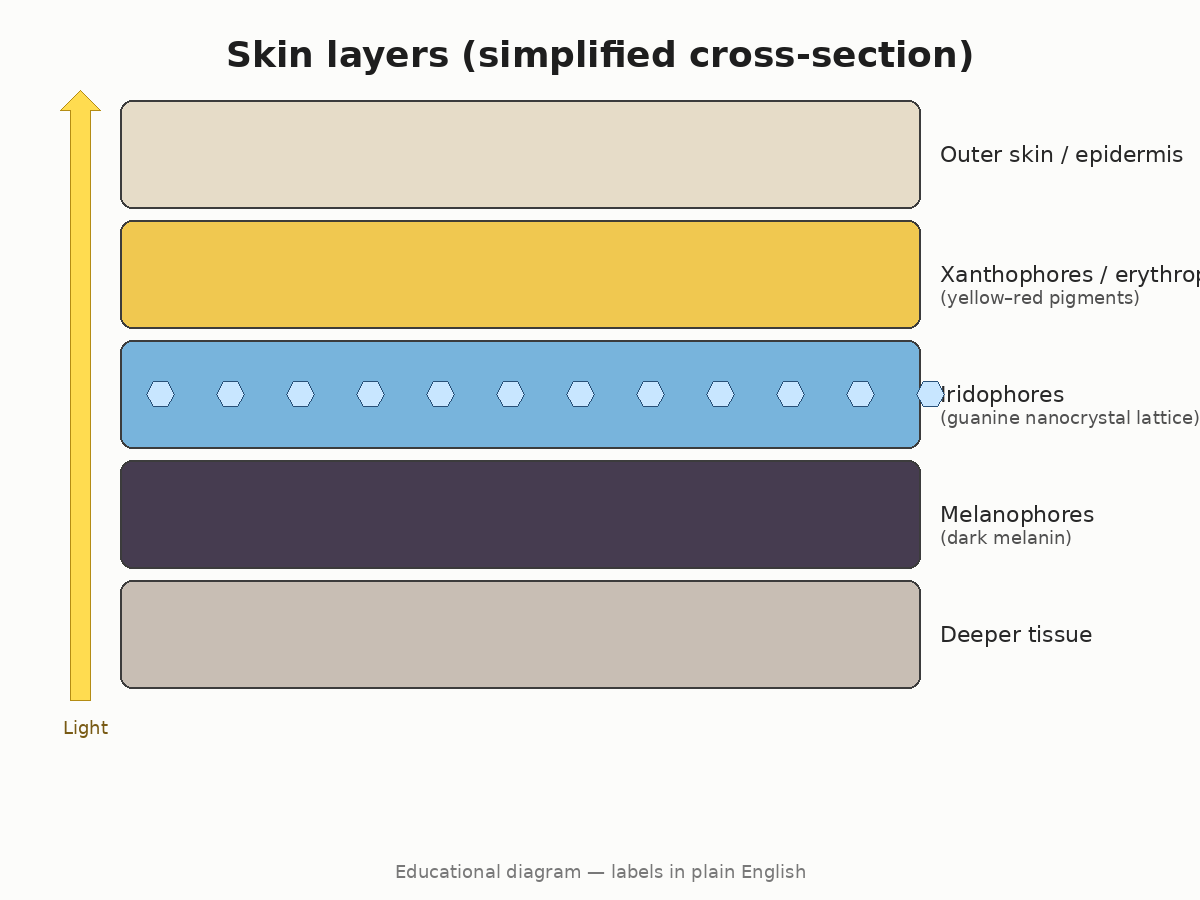
Chameleon skin is a layered optical system. Thinking of it as a stack helps: pigment cells and crystal cells occupy different depths, and light travels through that stack before bouncing back to an observer’s eye.
Simplified cross-section of the skin layers involved in color
Pigment cells (chromatophores)
Chromatophores are cells that hold pigment. In many lizards, including chameleons, yellow and red pigments often sit in cells sometimes called xanthophores and erythrophores. Those pigments absorb some wavelengths and let others through, so they can warm a structural blue or green toward lime, yellow, or reddish tones.
Deeper or among these layers, melanophores contain melanin. When melanin granules disperse or the dark layer becomes more prominent in the optical path, the animal can look duller, browner, or nearly black. When melanin is withdrawn or less influential, brighter structural colors can show through more clearly.
Pigment alone does not explain the fastest, most vivid shifts seen in animals like panther chameleons. Pigment redistribution can contribute to darkening and tinting, but the breakthrough insight of recent work is how much of the hue change rides on crystal spacing.
Crystal cells (iridophores) and reflected light
Iridophores are the crystal cells. In the superficial iridophore layer described in landmark work on panther chameleons (Teyssier and colleagues, Nature Communications, 2015), guanine nanocrystals are arranged in a roughly ordered lattice—effectively a biological photonic crystal. Photonic crystals reflect certain wavelengths preferentially based on spacing and refractive index.
When the animal is relatively calm, the lattice is typically more tightly packed, favoring reflection of shorter wavelengths. During excitement or social display, the lattice can expand: the preferred reflected color moves toward longer wavelengths. That is why a male that looked relatively blue-green can suddenly blaze with yellows and reds without needing to invent new pigment from scratch.
The same research also pointed to a deeper iridophore layer with larger, less orderly crystals that strongly reflect near-infrared light. That deeper layer is thought to play a passive role in thermal balance—helping manage heat load—rather than painting the bright display colors we notice most.
What tells a chameleon to change?
Skin architecture explains how color can shift. Physiology explains when. Exact molecular switches that push nanocrystal spacing in or out are still incompletely mapped—researchers have noted that those control mechanisms remain to be fully determined—but the broad drivers are clearer from behavior and natural history.
Social signals and mood
In many species, especially those with intense male–male rivalry or elaborate courtship, color change is tightly linked to arousal and social signaling. A rival appears; hormones and nerves ramp up; the lattice expands; colors intensify. A subordinate or less aroused animal may stay darker or more muted. Courtship can involve bright, contrasting patterns that advertise fitness or intent.
“Mood” here is a shorthand for physiological state—stress, excitement, submission—not a human-style emotional wardrobe. The animal does not pick a color from a menu the way a cartoon character might. Instead, internal state alters skin optics through pathways that science still only partly resolves at the molecular level.
Temperature and the environment
Chameleons are ectotherms: they rely on the environment to manage body temperature. Skin reflectance affects how much solar energy is absorbed. Darker tones can help absorb warmth; lighter or differently reflective states can reduce heating. The deep iridophore layer’s near-infrared reflection adds another thermal dimension that is less about visible “fashion” and more about physics of heat.
Temperature-related changes can be slower or subtler than the explosive social flashes, and they can interact with mood and context. A cold animal basking and a male mid-contest are solving different problems with the same skin toolkit.
Do chameleons change color to camouflage?
The short cultural answer—“yes, to hide”—is incomplete. The scientific answer is nuanced.
Flashy, rapid shifts toward high-contrast yellows and reds are poorly explained as camouflage. Predators and rivals notice those colors; that is often the point. Researchers describe social communication and physiological state as primary drivers of those dramatic changes in well-studied species such as panther chameleons.
That does not mean background matching never happens. Chameleons can adjust tone and pattern in ways that reduce contrast with foliage, bark, or light conditions. How much camouflage contributes versus social or thermal needs varies by species and situation. Treating every color change as stealth is a myth; treating camouflage as impossible is also too absolute. The honest line is: camouflage can matter, but it is not the main story behind the cartoon-famous flashes.
How fast can the change happen?
Speed depends on species, which layer is involved, and what is driving the change. Social displays in highly dynamic species can shift appearance over seconds to minutes—fast enough to look almost instantaneous to a casual watcher during a fight or courtship bout. Temperature-related adjustments may unfold more gradually as the animal moves between sun and shade or as body temperature drifts.
Because much of the rapid hue change is structural (lattice spacing) rather than wholesale pigment synthesis, the skin can reconfigure optical properties relatively quickly once the physiological signal arrives. Pigment redistribution, especially melanin-related darkening, can also contribute on behavioral timescales.
Exact stopwatch numbers differ across studies and species; what matters for understanding is that rapid structural change is biologically plausible and observed, while not every chameleon species performs the same high-speed light show.
Concept diagram of light bouncing from a crystal lattice
FAQ
Can all chameleons change color the same way?
No. Panther chameleons are a research poster child for lattice-based structural color change, but chameleons are a diverse group. Some species show more limited shifts; some emphasize darkening and lightening more than rainbow displays; life stage, sex, and health also matter. Findings from one species should not be copied onto every chameleon without care.
Is the color “chosen” on purpose?
Not in the sense of deliberating over a palette. Color change is a physiological response. The animal’s nervous and hormonal systems respond to social cues, arousal, and temperature, and the skin’s optical structures follow. Calling it “chosen” is a metaphor that can mislead. Calling it automatic optics under biological control is closer to the evidence—while admitting that the finest cellular control details are still an open research area.
Recap
How do chameleons change color? Through a partnership of guanine nanocrystal lattices in iridophores (structural color) and pigment chromatophores that tint and darken. Rapid shifts often track social signaling, mood/arousal, and temperature. Camouflage can contribute in some contexts, but it is not the full explanation for dramatic displays. Species differ, and molecular control of crystal spacing is not yet fully solved. The next time a chameleon flares from quiet green-blue into fiery contrast, you are watching physics of light meet animal communication—not a living paintbrush inventing camouflage on demand.